
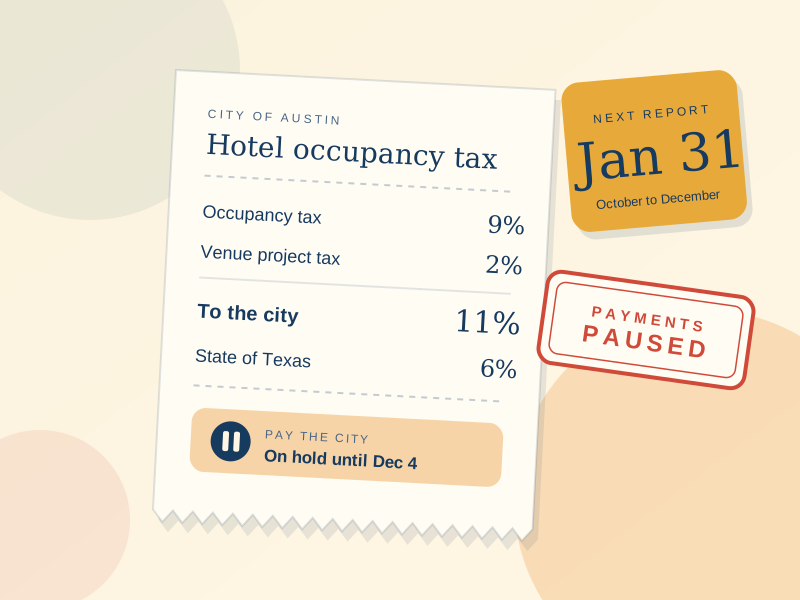
On November 13, Austin Financial Services told operators that hotel occupancy tax payments would stop for eighteen days while the city moves short-term rental taxes and licenses to a new system. You cannot pay the city from November 16 through December 3. That sounds worse than it is. The tax is reported by the quarter, the next report is not due until January 31, and if your bookings come through a platform, the platform has been sending the city's share for you since April 2025. Here is who owes what, when, and what the pause changes. The licensing half of the same switch is in its own entry.
What the city paused
Payments, for eighteen days. The city is not processing hotel occupancy tax payments from November 16 through December 3. The reason it gives is plain: it wants the records to land in the new system complete. Short-term rental services on Austin Finance Online, the portal operators pay through today, are unavailable for the same dates.
The cutoff that already passed. Operators who pay the tax but do not hold an STR license could still make tax and license payments in Austin Finance Online through Sunday, November 15 at 11:59 p.m. If that was you and you missed it, your next chance is the new system.
When it comes back. The notice says December. The city's short-term rental page gives the day: December 4.
What a host owes, in plain numbers
The pause does not change the tax. The City of Austin charges 11 percent on short-term stays: a 9 percent occupancy tax plus a 2 percent venue project tax. The State of Texas charges its own 6 percent on top of that, and the state's share is reported to the state, not the city.
The platform sends the city's tax
Since April 1, 2025, a platform that takes the guest's payment collects the city's hotel occupancy tax and sends it in for the operators who use it. The pause is between the city and the platform, not you.
You collect it, report it and pay it
Money you take outside a platform is yours to handle: collect the tax from the guest, report it for the quarter, and pay the city. This is the part the pause touches.
The quarterly calendar
Reports are due on or before the last day of the month after each quarter ends. The city asks for a report even in a quarter when you collected no tax.
- Jan to MarDue April 30.
- Apr to JunDue July 31.
- Jul to SepDue October 31. This one was due before the pause began.
- Oct to DecDue January 31, 2027. The pause sits in the middle of this quarter, and the report is due eight weeks after the new system opens.
Ask now, and keep the answer
The city's late charges are 5 percent of the tax due, another 5 percent on the 61st day past due, and interest at 10 percent a year from that day. The notice does not say any of that is waived while payments are paused. If you owed a payment and could not make it before the portal closed, do not guess.
- Email Austin Financial Services at hotels@austintexas.gov today.
- Say what you owe, for which quarter, and that the portal is closed.
- Ask how the pause is counted toward late charges.
- Keep the reply with your tax records.
A pause in payments is not a pause in the tax. The guest still paid it, and the quarter still ends December 31.RoGi Properties
What to do before December 4
- Sort this quarter's bookings into two piles: platform and direct. Only the direct pile is yours to report to the city.
- For every direct booking since October 1, log the dates, the nights and the amount the guest paid, and confirm you charged the tax.
- Set the tax you collected aside. It is the city's money that happens to be in your account.
- Save the November 13 notice with your records.
- When the new system opens, sign in early. The notice does not say whether accounts carry over, so confirm your payment history came across before January.
- Put January 31 on the calendar now, and file even if the number is zero.
Tax questions go to Austin Financial Services at hotels@austintexas.gov. The office says the new system is meant to be a simpler way to manage tax payments. We will update this entry once it launches and we have filed in it.
License and tax compliance is part of how we manage a home.
For the homes we manage, we keep the booking records a quarterly report needs and watch the dates so nothing is filed late. If you own a furnished home in Austin and want to know what it could earn as a hybrid, short stays and longer ones in the same year, start with a free evaluation.
Sources
Austin Financial Services notice to operators, "Upcoming Changes to Short-Term Rental Tax Payments" (November 13, 2026) · City of Austin: Hotel Occupancy Taxes · City of Austin: Hotel and Rental Tax · City of Austin: Short-Term Rentals · Austin Development Services: Pause in STR Licensing and Tax Payments Before New System Launch (November 9, 2026)
This article is a plain-English summary for owners, not legal or tax advice. The city can change its dates, rates and rules. Check the city's pages, ask the office above, or talk to your accountant before you act on a deadline.